On 1 January 2023, Czechia will hand over the Presidency of the Council of the European Union to Sweden, which holds its reigns once again, for the third time following previous tenures in 2001 and 2009. During the first half of 2023, the Swedish Presidency has to sail through troubled waters to address some of the most pressing EU issues.
The Presidency will be tasked with bringing the European Union out of a difficult winter of soaring energy prices and rising inflation, precipitated by the EU’s response to Russia’s war of aggression in Ukraine. Major obstacles, including how the EU should continue to support Ukraine’s fight for a European future, how it should alleviate the cost-of-living crisis hitting European citizens, and more, remain at the top of the agenda, exacerbated by Russia’s war. Amongst these issues, ongoing challenges remain: the climate crisis and impact of Russia’s war on the energy transition, the future of Europe in the context of rebuilding Ukraine after the war, and the ongoing impact of post-truth politics on democratic processes.
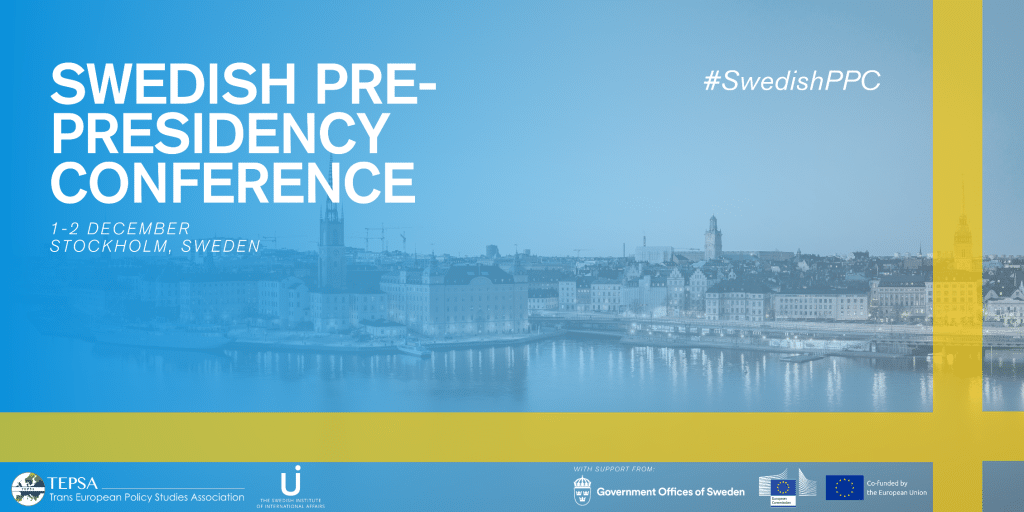
To scrutinise the priorities and challenges of the Presidency, TEPSA and its Swedish Member Institute, the Swedish Institute of International Affairs, hosted the Swedish Pre-Presidency Conference on 1 and 2 December 2022 in Stockholm and livestreamed online.
On the occasion of the Swedish Pre-Presidency Conference, TEPSA also presented to Swedish officials the Recommendations from the members of the TEPSA network to the Swedish Presidency. The TEPSA Recommendations are an institution of TEPSA Pre-Presidency Conference, with a long history.
WATCH: TEPSA Recommendations to the Swedish Presidency:
The conference brought together academics, policy-makers, media and civil society in order to discuss the agenda and challenges of the upcoming Presidency. More specifically, the conference addressed the impact of the Russian-Ukrainian war on the future of European security, but it also explored a number of other key issues, such as the energy transition in the context of soaring energy prices linked to the war, the future of the EU’s fundamental values in a context of post-truth politics, as well as the need for a humanitarian approach to migration and asylum policy.
WATCH: FULL PANEL RECORDINGS FROM THE SWEDISH PPC
War in Europe: Confronting New Realities
In the first plenary session of the conference, Swedish Institute of International Affairs Director Jakob Hallgren moderated a discussion between Swedish State Secretary for International Development Diana Janse, Magdalena Góra (Jagiellonian University), and Roderick Parkes (German Council on Foreign Relations).
The Future of the Union and its Fundamental Values
In this panel, which takes place in the context of the “Reclaiming Liberal Democracy in the Postfactual Age (RECLAIM)” project, Göran von Sydow, the Director of the Swedish Institute for European Policy Studies (SIEPS), moderated a discussion between RECLAIM Project Leader Maximilian Conrad (University of Iceland), Agnieszka Sadecka (Jagiellonian University), and Richard Youngs (Carnegie Europe).
Climate, Energy and Sustainability
This panel, moderated by Niklas Bremberg (Swedish Institute of International Affairs), consisted of a discussion between Simone Bunse (Stockholm International Peace Research Institute), Karina Barquet (Stockholm Environment Institute), and Aleksandra Palkova (Latvian Institute of International Affairs).
The Reconstruction of Ukraine and the Future of Europe
In this panel, which took place in the context of the “Differentiation: Clustering Excellence (DiCE)” project, was moderated by Fredrik Löjdquist (Stockholm Centre for East European Studies) and featured a discussion between Nona Mikhelidze (Istituto Affari Internazionali), Svitlana Chekunova (Razumkov Center), Torbjörn Becker (Stockholm Institute of Transition Economics), and Matteo Bonomi (Istituto Affari Internazionali).
Establishing an Effective, Humanitarian and Safe Migration Policy for Europe
This panel was moderated by Ezgi Irgil (Swedish Institute of International Affairs) and featured contributions from Pawel Busiakiewicz (DG HOME), Alexandra Wilton Wahren (Director-General for Legal Affairs at the Swedish Ministry of Justice), and Eleonora Milazzo (Egmont Institute & European Policy Centre).
Europe in a Competitive World
This panel, moderated by the European Policy Centre’s Director Fabian Zuleeg, featured a discussion between Jessika Roswall, Swedish Minister for EU Affairs, Cecilia Malmström (Peterson Institute for International Economics), and Ilke Toygür (Center for Strategic and International Studies).
Concluding Remarks
The final remarks at the Swedish Pre-Presidency Conference were delivered by Jakob Hallgren, Director of the Swedish Institute of International Affairs, and Prof. Lucia Mokrá, Chairperson of the TEPSA Board and Professor at Comenius University.
This Pre-Presidency Conference is organised by the Trans European Policy Studies Association (TEPSA) and the Swedish Institute of International Affairs. The event is supported by the Government Offices of Sweden, the European Commission Office in Sweden, as well as via TEPSA’s CERV Operating Grant. The DiCE project (under the European Union’s Horizon 2020 research and innovation programme under grant agreement No. 870789), and the RECLAIM project (under the European Union’s Horizon Europe research and innovation programme under grant agreement No. 101061330) are also supporting the PPC, through the organisation of parallel sessions. Learn more about the RECLAIM-supported parallel session here, and about the DiCE-supported parallel session here.